
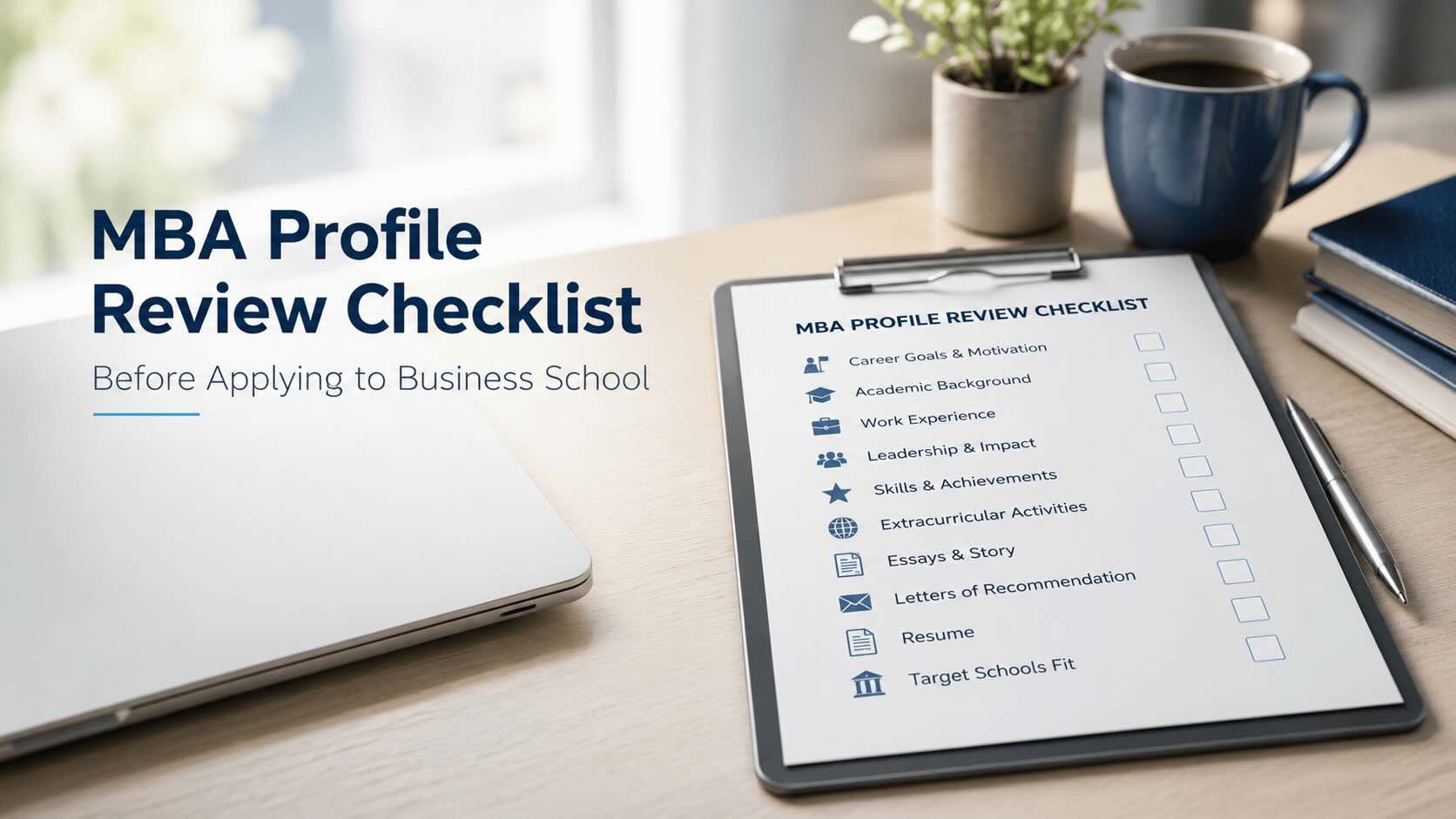
Quick answer: an MBA profile review is a structured check of your school fit, career story, academic readiness, leadership evidence, timeline, and application risks before you spend serious time or budget on MBA applications. The best profile review should leave you with a clear school list, a stronger narrative direction, and a practical next step.
If you are preparing for Harvard Business School, Stanford GSB, Wharton, Columbia Business School, INSEAD, London Business School, or another competitive MBA program, the question is not only “Am I impressive?” The better question is: Will an admissions committee understand why my background, goals, timing, and target schools make sense together?
This MBA profile review checklist gives you a practical way to assess your application before you begin essays, resume revisions, recommendations, or interview preparation.
What Is an MBA Profile Review?
An MBA profile review is a pre-application diagnosis. It looks at your education, test readiness, career record, leadership, goals, school fit, timing, personal story, and risk factors. The purpose is to identify whether your application strategy is realistic, distinctive, and aligned with what top MBA programs evaluate.
A strong review should not simply tell you whether you are “good enough.” It should show you where your profile is competitive, where it is unclear, and what must be improved before you apply.
MBA Profile Review Checklist: 15 Questions to Ask Before You Apply
1. Is your post-MBA goal specific enough?
Admissions committees want to understand what you want to do after the MBA and why the program is the right bridge. “Consulting,” “finance,” “entrepreneurship,” or “leadership” is usually too broad. A stronger goal includes industry, function, geography, and the reason your past experience supports that direction.
2. Does your career story explain your next move?
Your resume may show achievements, but your application needs logic. A strong MBA story connects where you came from, what you learned, what gap remains, and why business school is the next credible step.
3. Are your target schools realistic and well matched?
School fit is not only ranking. It includes class profile, industry placement, geography, curriculum, community, scholarship likelihood, and your competitiveness compared with similar applicants. A balanced school list usually includes reach, target, and safer-fit programs.
4. Do you have leadership evidence beyond job title?
Leadership can appear through team management, project ownership, mentoring, cross-functional influence, community work, founder experience, or measurable impact. The key is evidence. Admissions readers need to see what changed because of your actions.
5. Are your achievements quantified clearly?
Strong MBA applications translate work into outcomes: revenue, cost savings, user growth, market expansion, team size, process improvement, deal value, or operational impact. Numbers are not everything, but vague achievements are easy to forget.
6. Is your academic profile easy to trust?
Your undergraduate record, quantitative coursework, test score, professional certifications, and analytical work experience all shape academic readiness. If there is a weakness, the review should identify whether you need a stronger test score, additional coursework, or clearer evidence of analytical ability.
7. Have you identified your profile risks?
Common risks include unclear goals, average work impact, weak recommendations, low quant evidence, overrepresented industry background, career gaps, frequent job changes, or a school list that is too ambitious. Risk is manageable when it is identified early.
8. Can your recommenders support your story?
Recommendations should reinforce leadership, maturity, collaboration, and growth potential. If your recommenders only know your technical output, you may need to brief them carefully or choose someone who can speak to broader impact.
9. Is your essay direction distinctive?
A strong essay direction is specific to you. It avoids generic claims and focuses on decisions, trade-offs, values, failures, growth, and evidence. The goal is not to sound impressive; the goal is to sound credible, reflective, and memorable.
10. Does your resume read like an MBA resume?
An MBA resume is not a job description. It should highlight progression, scope, leadership, results, and business relevance. Every bullet should help the reader understand responsibility, action, and impact.
11. Is your timeline realistic?
Many applicants underestimate the time required for school research, tests, resume revision, essays, recommendations, and interview preparation. A review should show whether you are ready for Round 1, better suited for Round 2, or should wait for a stronger cycle.
12. Have you considered geography and career outcomes?
Program choice should connect to post-MBA location and industry access. A school may be globally respected but still less practical for a specific market, visa path, or recruiting goal.
13. Are you applying as a first-time applicant or reapplicant?
Reapplicants need a different review. The key question is what materially changed: stronger score, clearer goals, better leadership, improved school fit, sharper essays, or stronger recommendation strategy.
14. Do you know which parts need outside support?
Not every applicant needs full application consulting. Some need school selection, some need essay strategy, some need resume positioning, and some need interview preparation. The most efficient path is to identify the highest-leverage gap first.
15. Can you explain your next step in one sentence?
After a good profile review, you should be able to say something like: “I should target Round 2 with a refined school list, strengthen my quant evidence, and build essays around international growth leadership.” If your next step is still vague, the review is incomplete.
MBA Profile Review Scorecard
| Review Area | What Strong Looks Like | Warning Sign |
|---|---|---|
| Career goal | Specific industry, function, geography, and rationale | Generic “leadership” or “consulting” answer |
| School fit | Balanced reach, target, and safer-fit list | Only choosing schools by ranking |
| Story | Clear link between past, MBA, and future | Achievements without direction |
| Leadership | Evidence of influence and measurable impact | Title-heavy but outcome-light |
| Timeline | Enough time for tests, essays, recommendations, and interviews | Rushing applications close to deadline |
Common MBA Profile Review Mistakes
- Confusing brand-name school interest with school fit. A famous school is not automatically the right program for your goals.
- Starting essays before diagnosing the profile. Essays become stronger when the strategy is clear first.
- Ignoring weaknesses until late in the cycle. Low quant evidence, unclear career logic, or weak recommenders need time to fix.
- Trying to sound like every successful applicant. Admissions committees remember specific stories, not generic excellence.
- Choosing support too early. A profile review should clarify whether you need full support, targeted help, or only a better plan.
How Go2MBA Reviews an MBA Profile
Go2MBA starts with a practical diagnosis: school competitiveness, story potential, timeline, application risk, and next best move. The goal is not to push a package. The goal is to help you understand where you stand before you commit serious time, energy, or budget.
If you are unsure whether your school list, essay direction, or application timeline makes sense, start with a focused 15-minute review.
Book a free MBA profile review with Go2MBA
FAQ: MBA Profile Review
What is included in an MBA profile review?
An MBA profile review usually includes school fit, academic readiness, career story, leadership evidence, post-MBA goals, application risks, and timeline. A useful review should end with clear next steps.
When should I get an MBA profile review?
The best time is before you start essays or finalize your school list. Early diagnosis helps you avoid wasted effort and gives you time to fix weak points before deadlines.
Is an MBA profile review only for weak applicants?
No. Strong applicants also need profile reviews because competitive programs reject many qualified candidates whose goals, school fit, or story are not clear enough.
Can a profile review tell me which MBA schools to apply to?
It can help you build a smarter shortlist by comparing your goals, competitiveness, geography, career outcomes, and risk tolerance. A final list should balance ambition with realism.
Do I need full MBA admissions consulting after a profile review?
Not always. Some applicants need full application support, while others only need essay strategy, resume positioning, interview preparation, or school selection guidance.
Final Takeaway
The right MBA profile review gives you clarity before commitment. It helps you understand your competitiveness, choose better schools, avoid weak positioning, and move into essays with a stronger strategy. Before you ask “Which package should I buy?” ask “What is the real gap in my application?”
Explore Go2MBA admissions consulting services or schedule a free 15-minute MBA profile review.
Apply this to your profile
Want a cleaner read on your school list and application risk?
Use the article as a starting point, then pressure-test your own background, goals, deadlines, and school choices with a focused profile review.
Book Free Profile Review →